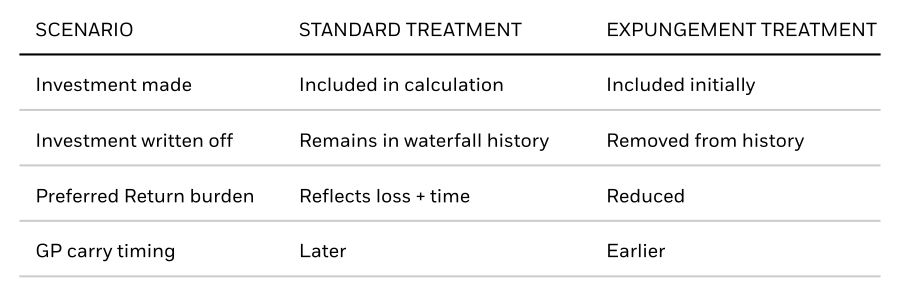
The result: the hurdle becomes easier – and faster – to clear, accelerating the point at which the GP begins earning carried interest.
In large funds, even modest changes in timing can translate into meaningful shifts in value between LPs and the GP.
What this tells us
This example illustrates how a seemingly technical provision can reshape fund economics. While such features are less prevalent today, their existence highlights a broader reality:
Economically similar waterfalls can produce very different outcomes depending on how they are implemented.
Example 2: Ambiguity in Preferred Return mechanics
A second, more common nuance arises not from explicit provisions – but from ambiguity.
Many LPAs clearly define the Preferred Return rate. Fewer define, with equal precision, how interim cash flows are treated when capital is partially realized, recycled, or redeployed.
In these situations, assumptions fill the gaps.
Different approaches, different outcomes
Across the market, multiple approaches can be observed:
- Continuous accrual: Preferred Return accrues on contributed capital until fully returned
- Dynamic adjustment: Accrual adjusts in response to partial realizations
- Prospective reset: Timing assumptions shift when capital is redeployed
Each approach is internally consistent. But each leads to a different economic outcome.
Why it matters
Without explicit definitions, LPs may not fully understand how the waterfall behaves until well into the fund lifecycle. In other words, the issue is not transparency – it is interpretability. And in a portfolio context, these differences can accumulate across managers, vintages, and strategies.
A structural challenge for LPs
Over the past decade, the private equity industry has evolved significantly. Reporting standards have improved, and conversations between LPs and GPs have become more transparent. At the same time, LPAs have grown more complex – and remain highly customized. In practice, this creates a structural disconnect:
- Terms may appear standardized on the surface
- Underlying mechanics often vary significantly
- Key assumptions are not always explicit
For LPs managing diversified portfolios, this raises an increasingly important question:
How do you systematically identify and compare these nuances across funds – and understand their economic impact?
From insight to scalable analysis
Identifying a single nuance within a single LPA is rarely the challenge. The challenge is doing so consistently:
- Across hundreds of agreements
- Across multiple managers and strategies
- Across evolving market practices
As portfolios scale, so too does the complexity of interpreting and benchmarking carry structures at a granular level. This is where the conversation is beginning to shift – from accessing documents to extracting intelligence from them. Because for sophisticated LPs, competitive advantage increasingly comes from:
- Understanding how terms are implemented – not just how they are described
- Comparing those implementations across the market
- Quantifying the economic implications of structural differences
Questions LPs are increasingly asking
As part of this shift, LPs are focusing diligence on implementation details, including:
- How are written-off investments treated in the waterfall?
- Does recycled capital affect the timing of the Preferred Return?
- Which cash flows are excluded or adjusted – and why?
- Where are assumptions implied rather than explicitly defined?
- How does this structure compare with similar funds?
These questions reflect a broader evolution: from reviewing terms in isolation to evaluating them in context.
The small print is strategic
For today’s LPs, the most important economic drivers are not always found in headline terms. They are embedded in definitions, assumptions, and structural mechanics – often expressed in just a few lines of legal drafting. Advances in document intelligence and legal data analysis are making it possible to evaluate these provisions at scale rather than agreement by agreement.
Understanding those nuances – and, critically, understanding how they vary across the market – is becoming a core component of investment decision-making. Because in private markets, the most meaningful differences are rarely the most visible. And in carried interest waterfalls, small words continue to move big dollars.
About eFront FAIR
This research draws on data and analysis from eFront FAIR, a solution that helps private markets investors validate fees, improve oversight, and enhance transparency across fund structures. Find out more.